Wildfire News
‹ All PostsWhen Wildfire Smoke Reaches the Starting Line
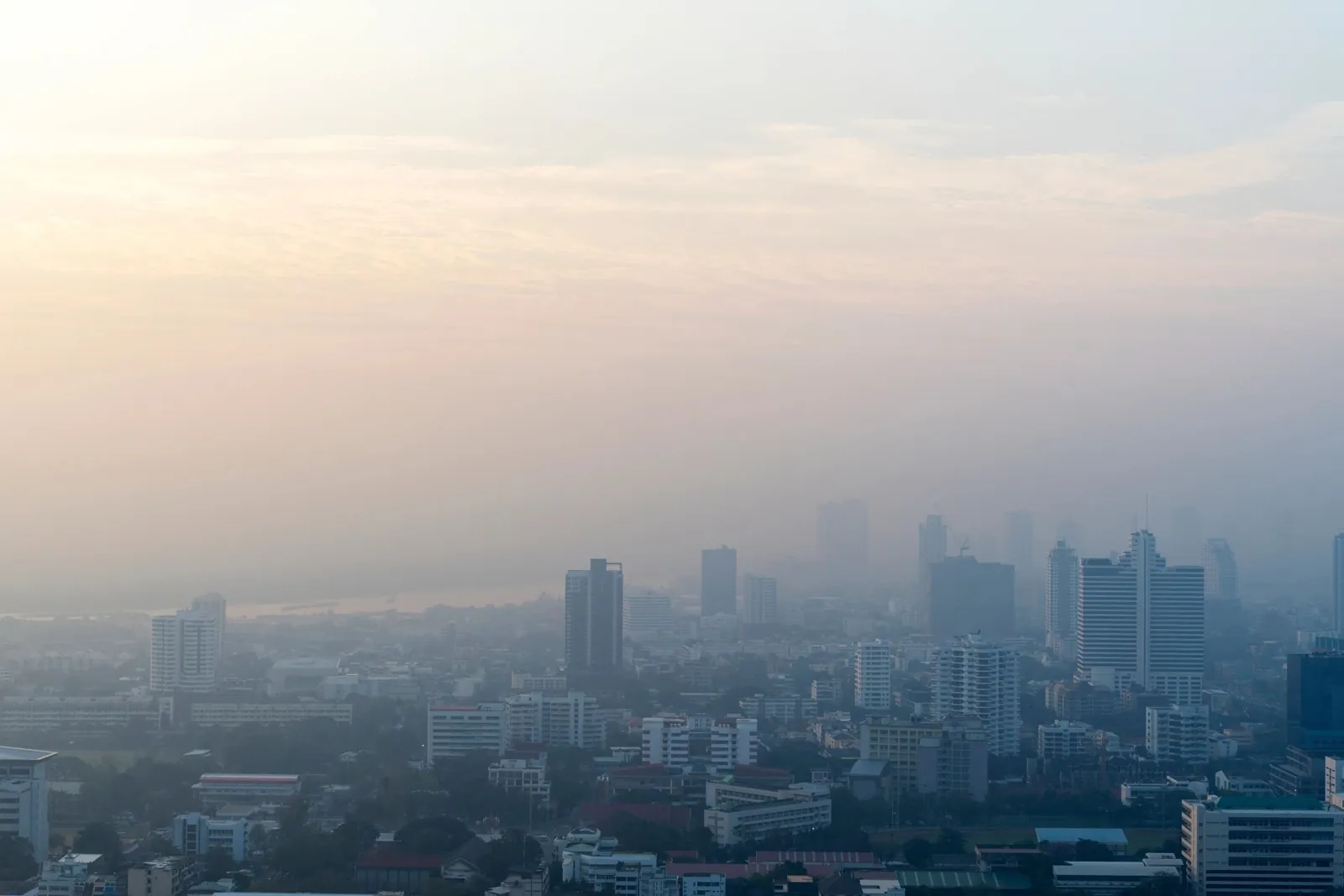
Image caption: Haze over a city skyline. Illustrative stock photograph, not a photograph of the September 2026 episode.
The fire can be hundreds of kilometres away. The decision is right outside the venue: should people train, compete or gather outdoors when the air has turned grey?
On 30 September, Bloomberg reported that haze linked to Indonesian fires had reached Singapore and Kuala Lumpur before two major motor-racing weekends. Formula 1’s calendar places the Bahrain Grand Prix at Malaysia’s Sepang circuit on 2–4 October and the Singapore Grand Prix on 9–11 October. The races were approaching as air quality became a practical planning problem. That does not mean either event would be cancelled. Sources: Bloomberg, 30 September 2026 and the Formula 1 calendar.
Smoke does not need a passport
Singapore’s National Environment Agency reported on the morning of 30 September that smoke plumes were visible from hotspot clusters in southern Sumatra, with haze also observed in parts of Kalimantan. Many monitoring stations in parts of Sumatra, Singapore and Peninsular Malaysia were reporting Unhealthy to Very Unhealthy air quality. Thick smoke and cloud obscured some of the satellite picture, so the agency cautioned that the full hotspot situation could not be determined. NEA regional haze situation, 30 September.
The weather may shift the exposure from one place or day to another. NEA expected dry conditions across much of the southern ASEAN region to persist in the following days, with showers in some areas. Rain might ease the haze locally. Where dry weather persists, the haze risk could stay high. A single photograph of the skyline cannot tell an event organiser what the air will be like several days later.
This is a recurring feature of wildfire smoke. The World Health Organization notes that smoke pollution can travel across regions and borders. Fine particles, or PM2.5, are a central health concern because they can be breathed deep into the lungs. Exposure may aggravate respiratory and cardiovascular conditions, especially for people who are already vulnerable. WHO, Wildfires and health.
The event decision is about exposure
Sport Singapore’s haze plan, updated on 28 September, gives a useful example of how to turn uncertain air quality into decisions. Its facilities use the 24-hour Pollutant Standards Index forecast to plan activities, with one-hour PM2.5 readings as supplementary information for immediate decisions. Operating hours and programmes can be adjusted to reduce exposure for staff and visitors. Sport Singapore haze management measures.
Those measures do not announce a change to either Formula 1 event. They show the kind of preparation that outdoor sport requires when conditions can vary. The relevant question is not whether a skyline looks dramatic enough for a headline. It is what the latest official reading and forecast mean for the people who will spend time outside: athletes, crews, spectators and workers.
Singapore’s NEA gives different advice according to the 24-hour PSI, a person’s health and how long and hard they will be active outdoors. In the Unhealthy range, healthy people are advised to reduce prolonged or strenuous outdoor exertion. Older people, pregnant women and children should minimise it. People with chronic lung or heart disease should avoid it. For decisions about the next few hours, NEA points readers to the one-hour PM2.5 reading. Local official advice should govern individual and event decisions. NEA haze advisory.
What a fire response can and cannot solve
Early identification and suppression at the source can limit some future smoke, but haze already in the air cannot be recalled by stopping one ignition. Peat and vegetation fires may be hard to reach. Smoke can combine emissions from many hotspots and travel with changing winds. Better detection, verified incident information, weather forecasts and public-health advice have to work together.
PRAESI is developing technology linking fire sensing, autonomous aerial suppression and operator oversight. It was not involved in the fires or the sporting events described here. Its proposed system’s performance must be established through testing. The present haze makes the reason for layered readiness plain: a fire can become a health and operations issue far beyond its mapped perimeter.
For the coming race weekends, no article written on 30 September can promise clear skies or predict a cancellation. Organisers and attendees need the newest official air-quality readings and event notices. The source of the smoke matters. So does the decision made where it arrives.
Frequently asked questions
Were the races cancelled? No cancellation is established by the sources used here. The Malaysia event is scheduled for 2–4 October and the Singapore event for 9–11 October. Readers should check organisers’ current notices.
Is haze the same thing as a nearby wildfire? No. Smoke can move far from its source. Air-quality readings and health guidance at the place of exposure matter even when the flames are elsewhere.
Which reading should guide outdoor plans? In Singapore, Sport Singapore uses the 24-hour PSI forecast for planning and one-hour PM2.5 as supplementary information for immediate choices. Follow the current guidance of the local authority.
Does a high pollution ranking tell people what to do? A city ranking is a snapshot that can change quickly. Local official readings, forecasts and health advice are more useful for decisions about a particular place and time.
Source note
Prepared on 30 September 2026 from Bloomberg’s report, NEA’s regional haze update and health advisory, Sport Singapore’s haze plan, Formula 1’s official calendar and WHO wildfire-health guidance. Conditions and event arrangements may change after publication.