Wildfire News
‹ All PostsFrom First Smoke to Fireline: How Wildfire Response Works
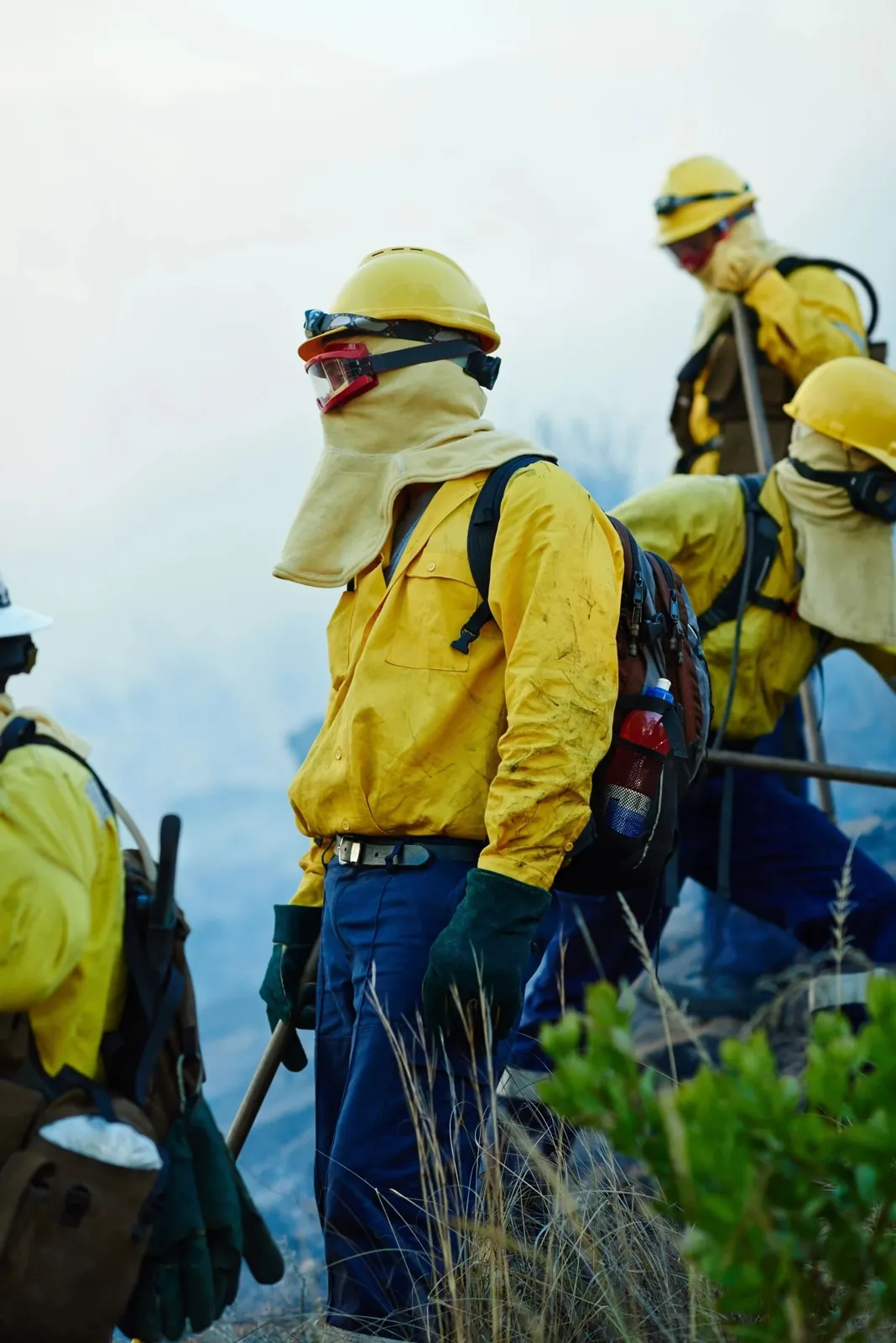
Image caption: Firefighters in protective gear amid smoky vegetation. Illustrative stock photograph; it does not show the South Dakota incidents discussed below.
Someone sees smoke and calls for help. What happens next is less cinematic than an airtanker dropping retardant, and far more complicated. A location must reach dispatch. Crews need to know where they can enter, where the wind is pushing the fire and whether the ground ahead is safe. If the incident grows, the right people and equipment have to arrive in the right order.
A Weather.com report from South Dakota’s Black Hills follows firefighters, dispatchers and pilots through that process. Its most useful lesson is about the handoffs between them. A quick alert helps only if it becomes a usable location and a safe plan.
The first call starts a chain
In the Black Hills, a member of the public or a volunteer fire department may spot the smoke first. The report describes a regional dispatch alert that sends available crews toward the location. The first responder on scene assumes incident command. That person must assess what is burning, the terrain, the weather and what lies in the fire’s path while more help is requested.
No universal response time covers this. Travel routes, visibility, access and available crews change from place to place. The National Interagency Fire Center describes local dispatch as the first tier of a wider system. When local capacity is stretched, resources can be ordered across a geographic area and then nationally.
The first report also needs checking. A smoke sighting is a reason to investigate, not proof of a mapped fire perimeter. Operators need to distinguish a new ignition from an existing incident, confirm its position and pass on uncertainty rather than hiding it.
The wind can ground the aircraft
Weather.com’s account of the Qury fire near Custer describes a difficult day for ground crews: strong wind drove rapid spread and kept aircraft from flying. The incident shows why response plans cannot depend on an aircraft arriving. Aircraft can help when conditions and airspace allow. They cannot be assumed available for every fire or every hour.
Even on a flyable day, different aircraft do different jobs. The National Interagency Fire Center’s aircraft guide describes airtankers, helicopters, aircraft for aerial supervision and planes that move firefighters. Their use has to fit the incident plan and the crews working below. A drop may help slow a flank or support a line; people on the ground still need to assess whether that line holds.
Firefighter safety governs the choice. Crews cannot simply follow a flame front into unsafe terrain because a map suggests a shorter route. Wind changes, spot fires and falling visibility can make an aggressive plan a bad one. In the Black Hills report, fire managers describe deciding where they can work without becoming trapped.
Containment is work, not a photograph
The most dramatic footage usually comes before the long shift on a control line. Crews build it, check for heat and return when conditions change. The National Wildfire Coordinating Group defines containment around a completed control line that can reasonably be expected to stop spread, including around spot fires. That is more specific than seeing fewer flames from the air.
For a developing fire, the operational picture changes throughout the day. Dispatch updates who is coming. Crews report what they find. Command revises priorities. Air resources, when available, work within that plan. And communities need clear information about what is known and what may change.
PRAESI is developing a wildfire-response system that links sensing, operator oversight and autonomous aerial suppression. It has not been deployed in the incidents described here, and its performance still requires testing and operational validation. The South Dakota account shows the problem such a system would have to fit into: it must give people useful information and preserve their authority to act. An alert, a map or an aircraft is valuable when it improves the next decision on the fireline.
Frequently asked questions
Who takes command when crews first arrive? In the South Dakota account, the first responder on scene assumes incident command. The command structure grows as the fire and response become more complex.
Can aircraft always stop a wildfire? No. Weather, visibility, airspace and aircraft availability can restrict flying. Ground crews and incident command remain central to the response.
Does containment mean the fire is out? No. Containment describes a control line expected to stop spread. Firefighters may still have substantial work to do inside and along that line.
Sources: Weather.com, Inside the race to stop a wildfire; NIFC mobilization and aircraft guidance; NWCG containment definition.