Wildfire News
‹ All PostsWhat Belgium’s High Fens Fire Reveals About Wildfire Readiness
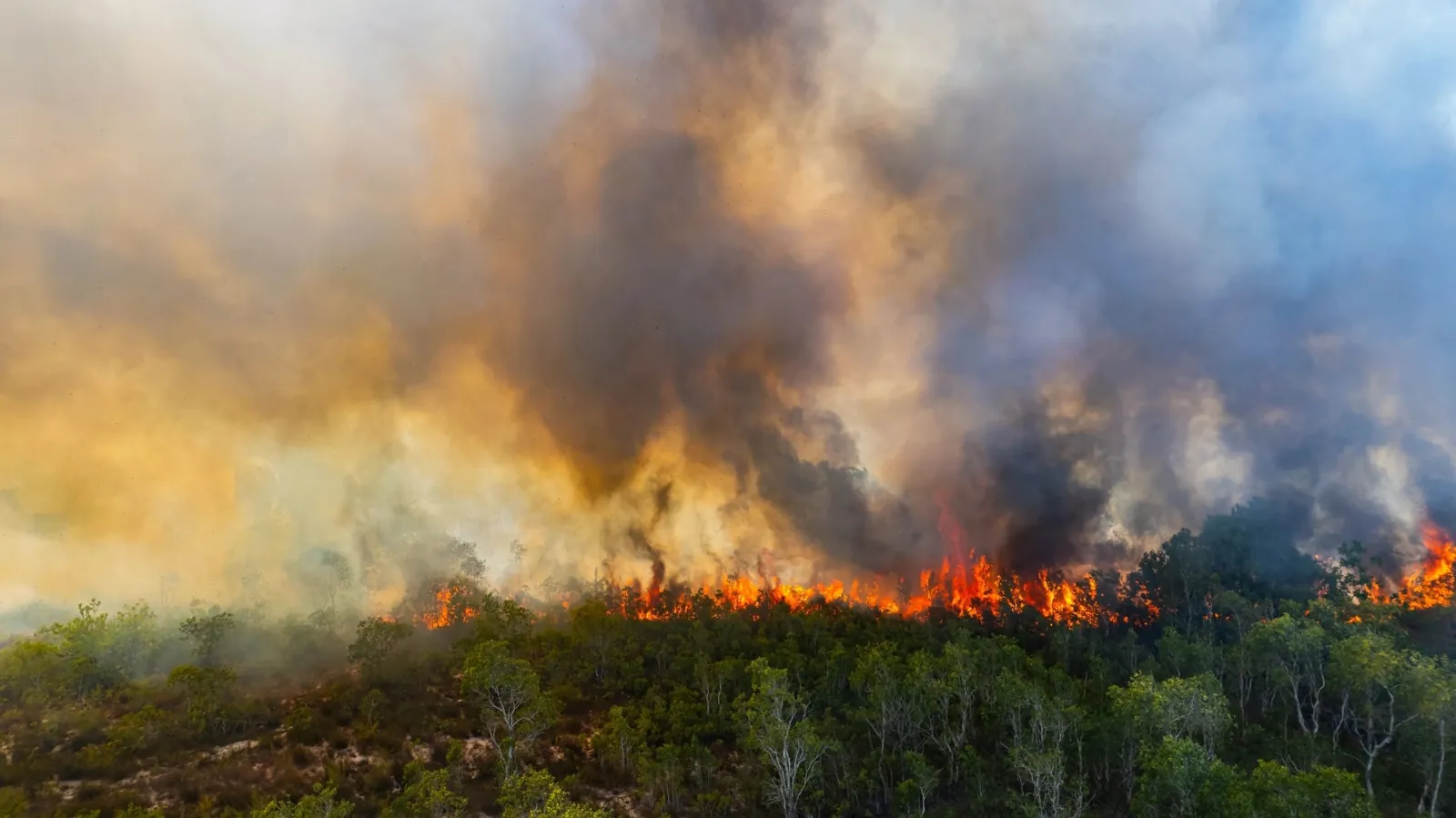
Villages and visitor accommodation faced precautionary evacuations, the fire approached the German border, and Belgium requested international support through the EU Civil Protection Mechanism. (Wallonie)
At the height of the response, around 500 firefighters and supporting personnel were reported to be involved, alongside soldiers, farmers, neighbouring-country responders and European aircraft. By the evening of 19 August, the operational picture had improved: the fire was stationary, limited flare-ups were being contained, and the residents covered by the remaining precautionary evacuations had been authorised to return. (Reuters)
Yet the incident was not over.
Affected forests and nature reserves remained closed. Several roads and reservoir sites were still restricted to protect the public and preserve emergency access. Smoke remained possible as rain reached heated ground, and continued observation was required. The fire had been contained operationally, but it had not been declared extinguished. (Wallonie)
The High Fens fire therefore offers a broader lesson for Europe:
Serious wildfire readiness is no longer relevant only to the Mediterranean south.
What happened in the High Fens
The wildfire started in the High Fens landscape on 14 August during a period of intense heat and very dry conditions. It expanded rapidly through protected heath, forest and peat-rich terrain in Liège Province. (Wallonie)
As winds and smoke affected the surrounding area, approximately 600 residents in parts of Waimes and Bütgenbach were told to leave as a precaution. Tourists were also advised to leave, and official Walloon reporting later said that 34 accommodation providers had been evacuated or directly disrupted. (AP News)
The response grew from a Belgian operation into a multinational European effort.
Firefighters and support personnel came from across Belgium, Germany and Luxembourg. The European Commission’s later deployment summary recorded two rescEU firefighting aircraft from Sweden and two helicopters each from the Netherlands, Norway and Germany. Belgium retained operational authority while international resources reinforced the national response. (ECHO)
The Belgian fire approached the German border, creating concern for communities around Monschau. However, none of the official sources reviewed confirmed that its physical perimeter crossed into Germany. A separate wildfire in Germany’s Hürtgen Forest was a different incident and must not be merged with the High Fens fire. (Sky News)
Belgian prosecutors opened an investigation into the cause. No final cause had been established at the reporting cutoff. (Reuters)
Why the historical record requires careful wording
Sky News and several early reports described the incident as Belgium’s largest wildfire ever.
That description is understandable within modern monitoring records, but it is not historically secure.
Research published through the University of Liège describes a major High Fens fire in 1911 that continued through much of August and September. The fire crossed what was then the Belgian-Prussian boundary and involved more than 2,000 soldiers. A later review of that historical work estimated that as much as 3,900 hectares may have been affected. (The Brussels Times)
The distinction matters because wildfire communication should remain accurate even when an event is exceptional.
The 2026 incident can responsibly be described as:
- Belgium’s largest wildfire in recent records;
- the country’s largest wildfire of the modern monitoring period;
- or one of the largest documented wildfires in Belgian history.
It should not be called the unquestioned largest wildfire ever recorded in the country.
Wildfire readiness is no longer only a Mediterranean concern
European wildfire planning has historically focused heavily on countries such as Spain, Portugal, France, Italy, Greece and Cyprus.
Those countries remain central to European wildfire preparedness. Their climate, vegetation, terrain and long operational experience make them especially exposed.
The High Fens incident does not erase that geography. It expands it.
By the end of July 2026, the area burned across Europe was already approximately 2.5 times the usual level for that point in the season, according to the European Commission. Belgium’s fire then developed during a wider August period that also brought major incidents in Greece, Croatia, France, Germany, Spain and the United Kingdom. (ECHO)
The Belgian incident suggests that northern and central European preparedness must increasingly consider combinations that may once have seemed less familiar:
- prolonged dry conditions;
- vegetation and organic ground capable of sustaining fire;
- protected landscapes with difficult access;
- communities and tourism activity close to natural areas;
- international borders;
- and the possible need for rapid European reinforcement.
This is an inference from the incident and wider 2026 conditions, not a claim that northern Europe now faces the same fire regime as the Mediterranean.
The operating environments remain different. The need for serious readiness is becoming more widely shared.
Key insight: Belgium’s High Fens fire shows that Europe’s wildfire map is broader than the Mediterranean. Readiness must extend to regions where peat, protected landscapes, border communities and international assistance create a different operating environment.
Peat can extend an incident beyond the visible flame front
The High Fens include peat-rich and marshy terrain.
Unlike a fire confined to visible surface vegetation, fire that enters organic ground may retain heat below the surface. It can continue smouldering after open flames have diminished and may produce renewed hotspots when conditions change.
Officials and field specialists warned that parts of the fire had penetrated the peat-rich ground, complicating access and creating the possibility of prolonged underground burning. (Reuters)
This does not mean the whole 3,000-hectare perimeter consisted of burning peat, nor does it establish how long every affected area will require monitoring.
It does mean that visible containment is not sufficient evidence of complete extinction.
For incident commanders, environmental authorities and protected-area managers, the operational horizon may extend well beyond the moment when the main surface front stops advancing.
A border-adjacent fire becomes an international concern
A wildfire does not have to cross an international boundary to create cross-border consequences.
Smoke can move across the border. Communities on both sides may require warnings. Roads, tourism activity and public access can be affected. Aircraft and firefighters may arrive from neighbouring states. Water, logistics and airspace coordination may acquire an international dimension.
The High Fens fire came close enough to Germany that German authorities monitored smoke and potential exposure around Monschau. German personnel also supported the response in Belgium. (Sky News)
That makes the event a border-adjacent civil-protection emergency with multinational assistance.
It does not make it a confirmed transboundary wildfire.
This distinction is important for accurate incident classification, legal responsibility and public communication.
European assistance is an operating system—not merely extra aircraft
The European response was highly visible through aircraft and helicopters.
The deeper capability was the coordination structure that allowed those resources to be requested, offered, received and integrated.
Following Belgium’s activation of the EU Civil Protection Mechanism, the European Commission coordinated two rescEU aircraft from Sweden, together with helicopters from the Netherlands, Norway and Germany. (ECHO)
Aircraft arriving from another country do not become operational merely by crossing the border.
They must be received into an authorised command structure. Their role must be defined. Airspace must be coordinated. Local and visiting teams require current information. Ground personnel must understand how aerial activity relates to their own assignments.
Belgian authorities remained responsible for the operation. European assistance expanded available capacity rather than replacing national command.
That is the strategic value of mutual assistance: not only more equipment, but an established pathway for integrating support during exceptional demand.
Aerial capacity still depends on conditions
Aircraft can provide reach where terrain is difficult, access is restricted or a fire front extends beyond what ground teams can approach safely.
Their usefulness is nevertheless conditional.
Visibility, smoke, cloud, wind, crew availability, aircraft role and airspace coordination can all affect whether an asset is able to operate. In the latest Walloon update, authorities were hoping for sufficiently favourable weather to allow further aerial activity after some aircraft had operated earlier that day. (Wallonie)
This is why nominal fleet size is not the same as operational capacity.
A serious readiness assessment asks not simply how many aircraft exist, but which are:
- serviceable;
- crewed;
- appropriately located;
- suitable for the required role;
- integrated into command;
- and genuinely available under current conditions.
Emerging aerial systems must be considered inside that same operational reality.
Containment is not the end of response
Wildfire terminology is often compressed in public reporting.
“Contained,” “stationary,” “under control” and “extinguished” do not mean the same thing.
By 18 August, Copernicus described the High Fens fire as contained, while noting that operations continued in the eastern part of the affected area. The official Walloon update on 19 August described the situation as stationary and said that limited flare-ups were being contained. (EU Space Policy)
At the same time:
- forest and reserve access remained prohibited;
- several roads and reservoir sites remained closed;
- smoke was still possible;
- air and water monitoring continued;
- and responders remained on site. (Wallonie)
Containment concerns the control of spread.
Extinguishment concerns the elimination of active fire and residual heat to the level required by the competent authority.
Between those stages lie monitoring, hotspot management, environmental assessment, resource drawdown and continuing protection of the public.
Protected landscapes create dual responsibilities
The High Fens are not only a fireground. They are an environmentally sensitive nature reserve and an important visitor destination.
During the emergency, authorities had to protect residents, tourists, firefighters, access routes, water infrastructure and the wider landscape at the same time.
The response phase and the ecological-recovery phase require different expertise.
Firefighters and incident commanders focus on life safety, containment and operational control. Environmental specialists later assess habitat impact, peat condition, water quality, wildlife and recovery needs.
Official Walloon reporting said that no major wildlife problem had yet been identified around the secured perimeter, but a more complete assessment would follow when conditions permitted. It also confirmed that drinking-water analyses remained compliant, with enhanced monitoring planned for several weeks. (Wallonie)
Early reassurance should not be confused with a final ecological assessment.
The wider European context
Belgium’s emergency occurred during a broader period of European wildfire pressure.
Sky News separately reported deadly fires in Greece and Croatia, a major Landes fire in France, the distinct Hürtgen Forest fire in Germany and multiple incidents in South Wales. These were separate fires with different causes, consequences and command structures. (Sky News)
Their simultaneous occurrence matters at a systems level.
European countries do not request assistance from an unlimited pool. Aircraft, crews and specialist teams may already be committed elsewhere. A period of widespread fire activity can therefore reduce the support immediately available for the next country that requires reinforcement.
This makes readiness a network question as well as a national one.
Human command remains central
Multinational assistance and emerging autonomous capabilities must remain within accountable public authority.
Wildfire operations affect communities, protected land, airspace, roads, reservoirs, responders and public resources. Decisions require legal authority, professional judgement and a clear command structure.
Technology may support authorised responders with additional capability or clearer information.
It should not independently decide:
- which community receives priority;
- when an evacuation is lifted;
- whether an aircraft may operate;
- how environmental trade-offs are resolved;
- or when an incident should be declared extinguished.
Human oversight is not an obstacle to advanced wildfire technology.
It is the foundation that makes its use responsible.
The PRAESI perspective
PRAESI is developing a patented integrated wildfire-response platform that publicly brings together field deployment, aerial suppression capability, sensing, post-action assessment, repeatable readiness and operator oversight.
PRAESI was not involved in the High Fens incident. It did not participate in Belgium’s national response or the EU Civil Protection Mechanism deployment. It does not claim specialist peat-fire extinction capability or that its developing system would have prevented the reported burned area.
PRAESI remains on a staged proof-build pathway. Its technical, intellectual-property, integration and deployment details remain under controlled disclosure. (PRAESI Technologies Ltd)
The responsible connection is strategic.
The High Fens fire shows why wildfire-response systems must be relevant beyond historically familiar fire regions. They must operate within changing terrain, weather, access and resource conditions. They must complement established responders, accommodate outside assistance and preserve operator visibility throughout the incident.
PRAESI’s public position is that wildfire response should be considered as a connected and accountable system—not as a collection of isolated aircraft, sensors or software tools. (PRAESI Technologies Ltd)
No proprietary implementation detail is required to understand that principle.
Questions European wildfire readiness should ask
- Which northern and central European regions may face wildfire events beyond their recent operational experience?
- How should modern monitoring records be compared with incomplete historical records?
- Which protected landscapes contain peat or organic ground capable of prolonged smouldering?
- How are residents, tourists and border communities incorporated into warning plans?
- How quickly can neighbouring-country and EU assistance integrate with national command?
- How is actual aircraft availability distinguished from nominal fleet size?
- How are smoke, cloud and weather changes reflected in authorised decisions?
- How is containment distinguished from final extinguishment?
- What environmental and water monitoring continues after residents return?
- How are multinational assignments and completed actions documented?
- How can emerging systems support authorised responders without exposing sensitive designs or adding operational complexity?
These are forward-looking readiness questions, not criticism of the Belgian or international responders involved.
Conclusion
Belgium’s High Fens fire demonstrates that very large European wildfire emergencies are not confined to the Mediterranean.
The operating environment in eastern Belgium was distinctive: peat-rich protected terrain, difficult access, nearby communities and tourism activity, proximity to Germany and the need for rapid multinational reinforcement.
Belgian firefighters, Civil Protection personnel, military teams, environmental specialists, farmers, local authorities and responders from neighbouring and European countries worked together to stop the main spread.
By 19 August, the situation had stabilised and evacuated residents had returned. The operation nevertheless continued, and the fire had not been declared extinguished. (Wallonie)
Technology cannot eliminate wildfire risk.
European assistance does not remove the need for national command.
Containment does not remove the need for assessment.
And modern records should not be confused with the complete historical record.
Responsible innovation should strengthen the parts of wildfire readiness that become most important under pressure:
- earlier positioning;
- clearer operational awareness;
- dependable availability;
- continuing assessment;
- interoperability;
- and accountable human oversight.
The High Fens fire did more than burn an exceptional area of Belgium.
It widened Europe’s understanding of where serious wildfire readiness may be required.
FAQ
What happened during the High Fens wildfire?
The fire began near Baelen in eastern Belgium on 14 August 2026 and affected approximately 3,000 hectares of the High Fens nature reserve. It prompted precautionary evacuations and required substantial Belgian and European assistance. By 19 August, the situation was stationary and limited flare-ups were being contained, but the fire had not been declared extinguished. (Wallonie)
Was this Belgium’s largest wildfire ever?
It was the largest wildfire in Belgium’s recent or modern monitoring record. Historical research indicates that a High Fens fire in 1911 may have affected up to approximately 3,900 hectares, potentially exceeding the 2026 fire. “Largest in recent records” is therefore more accurate than “largest ever”. (The Brussels Times)
Did the Belgian fire cross into Germany?
No official source reviewed for this article confirmed that the physical High Fens fire perimeter crossed the border. The fire approached Germany, smoke and precautionary concerns affected the border area, and German resources assisted Belgium. A separate fire in Germany’s Hürtgen Forest was a different incident. (Sky News)
Why can peat prolong a wildfire incident?
Organic and peat-rich ground can retain heat and smoulder below the visible surface after open flames decrease. This can produce residual hotspots or renewed flare-ups and may require prolonged monitoring. It does not mean every part of the High Fens perimeter was burning underground. (Reuters)
How did the EU Civil Protection Mechanism support Belgium?
Belgium activated the mechanism and received two rescEU firefighting aircraft from Sweden, together with helicopters from the Netherlands, Norway and Germany. These assets supported Belgian-led operations; the EU did not replace national incident command. (ECHO)
What is PRAESI developing?
PRAESI is developing a patented integrated wildfire-response system connecting field deployment, aerial suppression capability, sensing, assessment, repeatable readiness and operator oversight. It remains on a staged proof-build pathway and was not involved in the High Fens response. (PRAESI Technologies Ltd)
SOURCE NOTE
Source note: This article contains independent commentary and analysis inspired by Sky News reporting published on 16 August 2026 concerning the High Fens wildfire and other European emergencies.
Incident facts and status were checked against the official Walloon incident page, Copernicus Sentinel-2 reporting, the European Commission’s civil-protection update and corroborating Reuters and Associated Press coverage.
The fire is described as Belgium’s largest in recent or modern records. Historical research identifies a potentially larger High Fens fire in 1911, making an unqualified “largest ever” description unreliable.
Figures and incident status are stated as of 19 August 2026 at 19:00 CEST. All original reporting, photography, video, satellite imagery, maps and graphic rights remain with the respective publishers, authorities and credited creators. (Sky News)