Wildfire News
‹ All PostsThe First Hours Matter: Texas’s Ross & Rapid Wildfire Escalation
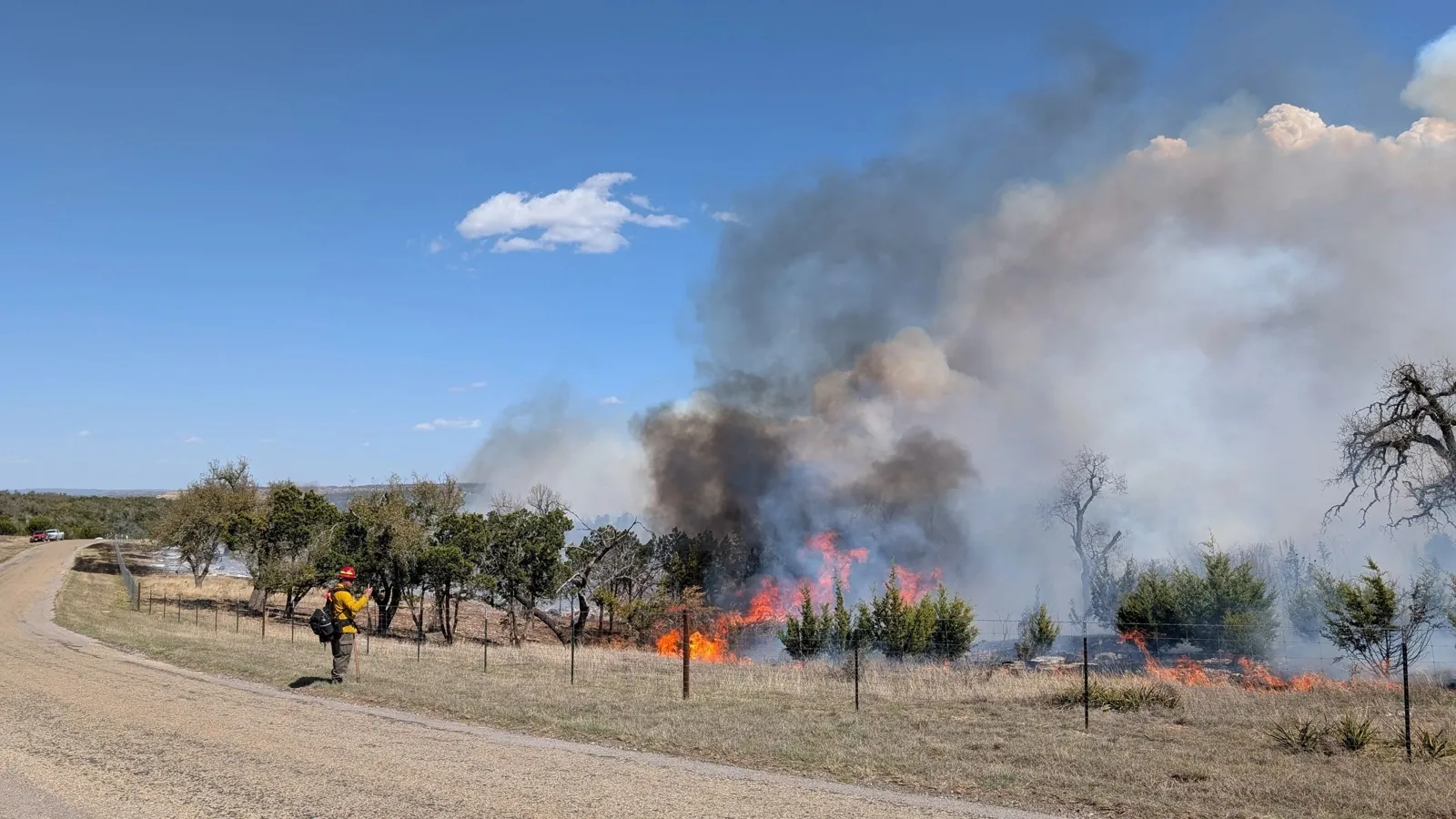
A wildfire does not need weeks to become a regional emergency.
The Ross Fire demonstrated that in North Texas.
The fire began on 24 August near Palo Pinto, west of Fort Worth. Within hours, what had started as a local grass and ranchland incident was demanding a much larger response.
By the following morning, officials estimated that approximately 50,000 acres had burned.
By Wednesday, the estimate had moved beyond 80,000 acres.
By Friday morning, Texas A&M Forest Service information placed the Ross Fire at approximately 85,000 acres across Palo Pinto and Jack counties, with 26% containment. (NBC 5 Dallas-Fort Worth)
No injuries had been reported at that point, but homes, ranch properties and structures—including buildings at the historic Worth Ranch youth camp—had been affected. The complete property assessment remained unfinished. (AP News)
The fire’s significance therefore extends beyond its acreage.
It demonstrates how rapidly an emergency system may have to change scale.
Local firefighters can begin responding to one fire and, within a short period, find themselves operating inside a multi-county emergency involving evacuation, structure protection, aviation, medical support, law enforcement, transportation, utilities, agriculture and statewide mutual aid.
That transition is one of wildfire response’s most demanding moments.
What happened during the Ross Fire
The first call was reported shortly after midday on Monday, 24 August.
NBC 5 reported that Palo Pinto County Emergency Services District No. 1 was notified at approximately 12:26 p.m. Crews arrived within minutes. Within roughly an hour, the incident had escalated to five alarms. (NBC 5 Dallas-Fort Worth)
By that evening, the fire was already estimated at around 7,000 acres.
Then came the acceleration.
By Tuesday morning, authorities estimated approximately 50,000 acres had burned, with containment at about 5%. The fire had expanded from Palo Pinto County towards Jack County. (NBC 5 Dallas-Fort Worth)
The state response expanded with it.
On 25 August, the Texas Governor’s office reported that approximately 630 homes had been subject to evacuation and confirmed FEMA’s approval of an FMAG. State agencies were supporting fire suppression, medical response, transportation, law enforcement, agriculture, utility monitoring and environmental functions. (Texas Governor’s Office)
By Wednesday, the acreage estimate exceeded 80,000.
By Friday morning, the official figure had reached approximately 85,000 acres and 26% containment. (The Texas Tribune)
The Ross Fire had become one of the largest recorded wildfires in the Dallas–Fort Worth area’s history. The National Weather Service’s Fort Worth office placed it behind the 2011 Possum Kingdom Complex within that specific regional comparison. (The Texas Tribune)
Yet its most important characteristic may have been speed rather than rank.
Why the first hours matter
Wildfire response operates with incomplete information.
At the beginning of an incident, authorities may not yet know:
- how large the perimeter really is;
- which direction will become most consequential;
- how many structures may ultimately be exposed;
- how weather will affect behaviour;
- how many resources will be required;
- or how long the operation will last.
Meanwhile, decisions cannot wait for perfect information.
Communities may require warnings.
Ground crews must protect structures.
Additional departments may need to be requested.
Roads and public services may be affected.
Aircraft and specialist resources may become necessary.
Command arrangements may have to expand.
The Ross Fire compressed many of these pressures into a short period.
That is why the first operational hours matter so much—not because every large fire can be stopped immediately, but because the emergency surrounding the fire may be changing faster than a static operating picture can describe it.
Growth rate and final acreage measure different things
A final wildfire perimeter tells us where fire eventually travelled.
It does not tell us how difficult the first operational period was.
Consider two hypothetical incidents that both finish at 80,000 acres.
One may accumulate that area over several weeks in remote territory.
Another may expand dramatically over a few days while threatening homes, roads and infrastructure.
The final number may look similar.
The operational problems are not.
The Ross Fire illustrates this distinction particularly well.
Its rapid expansion required authorities to respond to the changing consequences of the incident while perimeter estimates themselves were still being revised.
That is why wildfire readiness should not be judged through final acreage alone.
Scale matters. Rate of change matters too.
Rural terrain does not mean low consequence
The Ross Fire burned primarily across rural ranchland.
That description can create the wrong impression.
Rural land is not empty land.
Across Palo Pinto and Jack counties, the operating environment included:
- homes;
- ranches;
- livestock;
- agricultural operations;
- youth facilities;
- businesses;
- roads;
- utilities;
- and widely dispersed communities.
Associated Press reported damage to structures, including buildings at Worth Ranch, while local reporting documented losses to homes and ranch properties. No casualties had been reported at the article’s cutoff. (AP News)
Sparse population can also create its own emergency-management challenges.
People may live farther apart.
Road networks may offer fewer alternatives.
Fire departments may cover large geographic areas.
Livestock creates evacuation and welfare considerations that do not exist in a dense urban neighbourhood.
Critical infrastructure may serve communities across long distances.
The consequence of a rural wildfire therefore cannot be measured simply by counting people per square kilometre.
Crossing a county boundary changes the operating system
Fire does not recognise administrative borders.
Emergency-management systems do.
As the Ross Fire moved from Palo Pinto County into Jack County, the physical fire remained one incident.
The administrative environment widened.
Another county means additional:
- public authorities;
- emergency-management responsibilities;
- road systems;
- law-enforcement organisations;
- schools and public institutions;
- community-warning requirements;
- and local resources.
That makes county-to-county spread operationally important even though the boundary itself has no effect on the flames.
The challenge is to expand coordination without fragmenting command.
Mutual aid must scale without fragmenting command
The Ross Fire response brought together small rural departments closest to the incident, Texas A&M Forest Service and departments from across the Dallas–Fort Worth region. (The Texas Tribune)
Texas also made a wider network of state capabilities available.
The Governor’s office listed support spanning firefighting personnel, heavy equipment, aviation, emergency medical capability, transportation, law enforcement, agricultural assistance, environmental monitoring and utility coordination. (Texas Governor’s Office)
The significance is not simply the number of resources.
It is whether those resources can become part of one authorised response.
Mutual aid works when additional capability strengthens the incident structure rather than creating parallel operating pictures.
A large emergency needs more resources.
It also needs clarity over who is responsible for what.
Federal financial support is not federal command
FEMA’s approval of an FMAG is another useful distinction.
The grant recognised that the Ross Fire threatened destruction severe enough to justify federal cost-sharing.
It did not federalise the wildfire response.
Texas remained eligible for reimbursement of 75% of qualifying suppression costs, while state and local authorities continued leading the operation. (Texas Governor’s Office)
This matters because emergency funding and emergency command are different functions.
A jurisdiction can receive federal financial assistance without surrendering operational authority.
That distinction is central to understanding the layered US disaster-response system.
Aviation and ground response are complementary
Large wildfires often make aircraft the most visible part of the response.
But visibility should not be confused with completeness.
Aircraft may support authorised suppression and observation across large or difficult terrain.
Ground crews remain essential for:
- structure protection;
- close incident work;
- community access;
- road-level operations;
- and the physical tasks required around homes and infrastructure.
Texas’s available response capability included both ground and aerial resources. (Texas Governor’s Office)
The relevant question is therefore not whether wildfire response should rely on aircraft or firefighters.
It is how different authorised capabilities complement one another inside a coherent command structure.
Operational availability is more than fleet size
Emergency capability is frequently discussed through inventory.
How many aircraft?
How many engines?
How many firefighters?
Those figures matter, but they do not describe what can actually respond at a particular moment.
An asset contributes to immediate operational capacity only when it is:
- serviceable;
- appropriately staffed;
- positioned within useful reach;
- supplied;
- authorised for the required role;
- and not already committed to another incident.
This distinction becomes increasingly important during periods of widespread wildfire activity.
The next fire does not receive access to every asset that exists on paper.
It receives access to what remains genuinely available.
Containment is not extinction
The Ross Fire was reported at 26% containment at the cutoff. (The Texas Tribune)
That does not mean 26% of the acreage had been extinguished.
Containment describes progress in establishing control around the perimeter where authorities expect measures to prevent further spread under anticipated conditions.
The remaining percentage should not automatically be interpreted as actively burning land.
Nor does increasing containment immediately end the incident.
Responders may still need to:
- monitor conditions;
- deal with remaining hotspots;
- assess structures;
- evaluate infrastructure;
- manage smoke;
- adjust public restrictions;
- and restore crews and equipment to readiness.
Wildfire response has a tail.
The visible expansion of the perimeter is only one stage.
Fire weather influenced spread—not necessarily ignition
North Texas was experiencing severe heat and dry conditions when the Ross Fire developed.
On 25 August, the Governor’s office said much of Texas had experienced little or no rainfall and repeated triple-digit temperatures, contributing to persistent wildfire danger. (Texas Governor’s Office)
Associated Press also reported high winds, extreme heat and dry conditions as important factors in the fire’s rapid behaviour. (AP News)
Those conditions help explain why fire could spread aggressively.
They do not establish how the Ross Fire started.
At the reporting cutoff, the cause remained under investigation.
That distinction matters.
Fire weather explains the environment in which an ignition develops. It does not automatically explain the ignition itself.
Every intervention should improve the next decision
Wildfire response cannot be reduced to a sequence of visible suppression actions.
After an authorised intervention, decision-makers still need to understand:
- what changed;
- what remains uncertain;
- which resources remain committed;
- which capabilities can return to readiness;
- and whether the next decision should differ from the last.
This is especially important during rapidly evolving incidents.
Information that was current an hour earlier may no longer describe the same operating environment.
Assessment therefore matters not simply for the eventual after-action report.
It matters because it informs what happens next.
Human command remains central
Rapid escalation increases the temptation to frame technology as the answer to complexity.
It is not.
Evacuation affects people’s lives.
Aircraft operate in regulated airspace.
Resources are finite.
Homes, livestock, infrastructure and communities may compete for urgent attention.
Those decisions require public authority and professional judgement.
Technology should support authorised command with clearer awareness and dependable capability.
It should not independently decide:
- which community receives priority;
- when residents should evacuate or return;
- which public asset should be reassigned;
- whether airspace is safe;
- or when an incident is considered controlled.
Human oversight is not separate from advanced wildfire technology.
It is what makes its use accountable.
The PRAESI perspective
PRAESI is developing a patented integrated wildfire-response system that publicly connects field deployment, aerial suppression capability, sensing, post-action assessment, repeatable readiness and operator oversight.
PRAESI was not involved in the Ross Fire.
It is not part of Texas A&M Forest Service, TDEM, TIFMAS, FEMA or the incident-management structure. PRAESI does not claim that its developing system would have prevented the fire’s rapid growth, evacuations or property losses.
Nor does PRAESI position emerging aerial capability as a replacement for local fire departments, existing firefighting aircraft or professional