Wildfire News
‹ All PostsIndonesia Moves to Revoke Land Rights Over Concession Fires
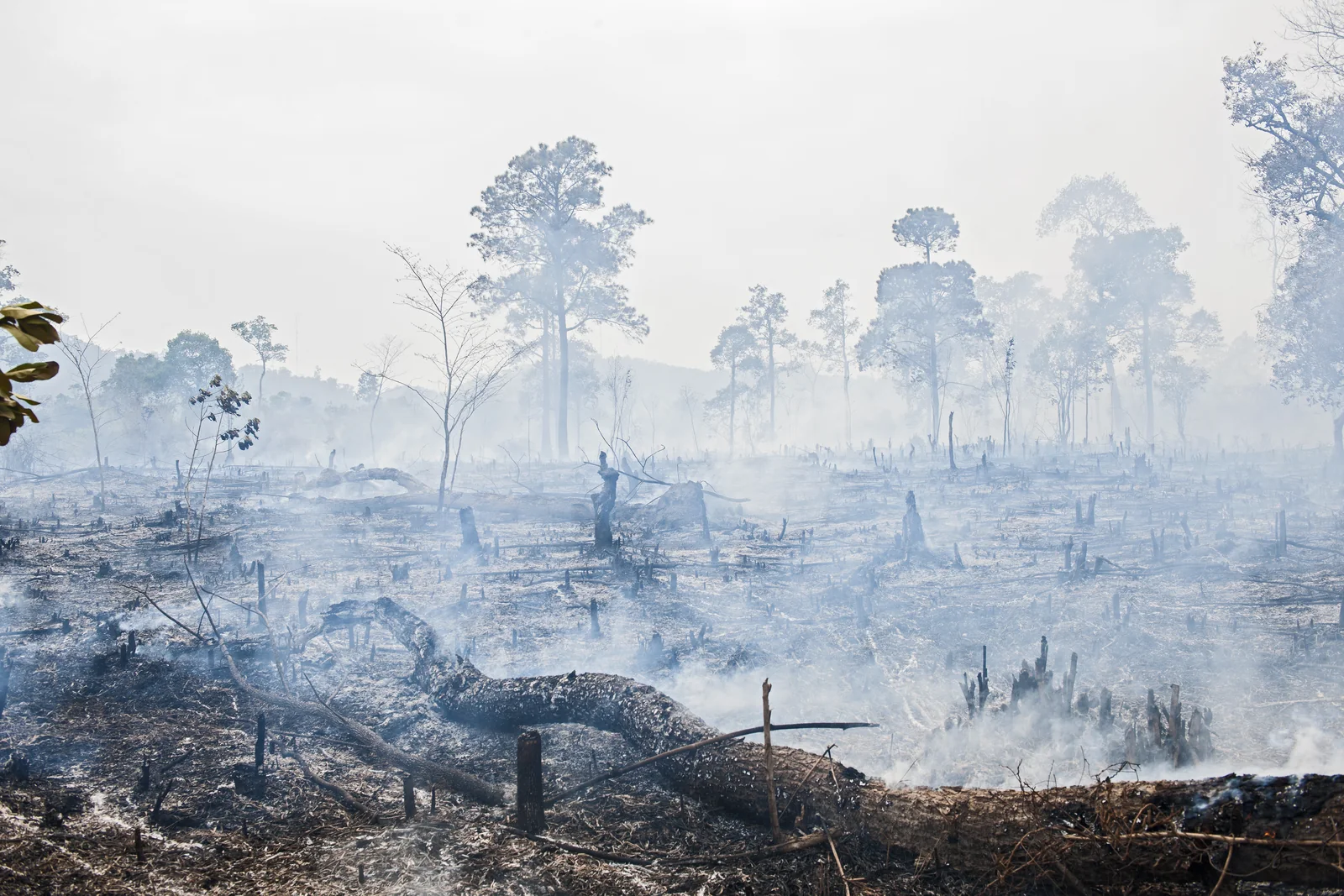
Forest burned to clear land for farming in Laos. Illustrative stock photograph, not one of the Indonesian concessions in this story. Photo: cavanimages / Envato.
Indonesia plans to take back land from companies whose concessions kept burning. On 9 November, Agrarian Affairs and Spatial Planning Minister Nusron Wahid said eight companies would lose land rights covering more than 42,000 hectares over their alleged involvement in forest fires, Reuters reported. Three more companies are still under review.
The move comes in what Reuters describes as Indonesia’s most intense fire season in 11 years, with large areas burned mainly on Sumatra, Borneo and Papua.
Five groups, five outcomes
The 11 companies hold hak guna usaha (HGU) cultivation rights or plantation permits. The ministry sorted them into five groups, according to Bernama and CNN Indonesia:
- Full revocation for three companies, covering about 23,000 hectares in South and West Kalimantan. More than half of each concession burned. The minister cited repeated fires, inadequate fire-prevention facilities and land-use violations.
- No renewal for one company in West Kalimantan whose 2,300-hectare concession expired in 2020.
- No new land rights for three companies that hold plantation permits but had not yet been granted HGU.
- Partial revocation for one company in West Kalimantan, covering about 1,510 hectares, where less than half the concession burned.
- Still under review for three companies with concessions of more than 11,000 hectares. The ministry has yet to decide whether to revoke all or part of their rights.
Eight of the 11 are in West Kalimantan, two in East Kalimantan and one in South Kalimantan. The government did not say what the companies grow. Nusron said some have beneficial owners linked to investors from South Korea, Malaysia and Singapore, without naming them.
These are announced decisions, not completed ones. The cases came from recommendations by the National Police’s Criminal Investigation Agency. Nusron told reporters that the data had been passed on and that draft decision letters were still being prepared. The companies have not been publicly named in full, and Reuters did not report any response from them.
Part of a wider crackdown
The land-rights move adds to earlier sanctions. In September, Forestry Minister Raja Juli Antoni said operating licences had been suspended for 26 companies, Antara reported. His ministry was then handling 46 fire-related cases, 15 against corporations and 31 against individuals.
The pressure also crosses borders. In October, Singapore’s exchange regulator questioned seven listed agriculture companies about possible links to the haze, and the government issued notices to companies it suspects of involvement, Mothership reported. According to Reuters, Singapore then summoned representatives of listed companies suspected of having fires on their Indonesian plantations.
The health toll keeps rising. More than 400,000 cases of acute respiratory infection had been recorded in seven provinces by 2 November, Reuters reported, citing Health Ministry data. When we covered Indonesia’s haze in September, the ministry’s count stood at 113,336.
The 50% line needs a map
The full-revocation group was defined by a number: more than half of each concession burned. Partial revocation applied where the burned share was smaller. That makes the burned-area measurement decisive for the outcome.
Getting it right means establishing where a fire started and where it spread. It also means checking how much of a concession it covered and whether it came back. Peat fires complicate each step, because they can smoulder below the surface long after flames are out. Haze can also hide the ground from aerial and satellite observation for days. Records of prevention equipment and patrols, which the ministry also weighed, are only as good as the inspections behind them.
Enforcement after a season is one lever. The fires themselves still have to be found and reached before they spread across a concession boundary, and the damage then has to be confirmed.
PRAESI is developing an operator-supervised wildfire-response system with human authorisation and outcome verification in its intended response chain. Indonesia’s decision letters will show how much weight the government puts on burned-area evidence. Where land rights depend on a percentage, that evidence has to be measured with care.
Read More / Sources
- Reuters: Indonesia to revoke land rights of eight firms for alleged involvement in wildfires, reporting by Bernadette Christina, 10 November 2026.
- Bernama: Indonesia to take tough action against 11 companies linked to forest fires, 10 November 2026.
- CNN Indonesia: breakdown of the five groups by province and area, 9 November 2026 (Indonesian).
- Antara: Indonesia suspends 26 corporate licenses amid wildfire crackdown, 16 September 2026.
- Mothership: Singapore’s actions on companies suspected of links to the haze, 19 October 2026.