Wildfire News
‹ All PostsBeyond the Fireline: Wildfire Smoke and the Hidden Health Toll
Beyond the Fireline: Wildfire Smoke and the Hidden Health Toll
The visible death toll of a wildfire is not necessarily its complete health toll.
Deaths caused directly by flames, burns, collapsing structures or evacuation emergencies may be identified relatively quickly. Smoke-related harm is more difficult to see. It can occur hundreds or thousands of kilometres from the fire and affect people who never saw the flames, entered an evacuation zone or appeared in an incident casualty report.
That distance can make the health burden appear disconnected from the fire that produced it.
The Economist’s latest Climate Issue analysis attempted to measure part of that hidden burden. Applying two peer-reviewed mortality approaches to July 2026 wildfire-smoke data produced very different numerical estimates—but the same broad conclusion: the acute health burden was substantially greater in North America than in Europe during the period analysed.
These figures are not official death counts. They are modelled estimates of excess mortality: the number of deaths statistically estimated to have occurred above an expected baseline following population exposure to wildfire-related fine particulate pollution.
That distinction is essential.
The figures come from applying published epidemiological relationships to current smoke data. They do not represent identified individuals, medical certificates or a verified list of wildfire-smoke fatalities.
The large difference between the two estimates is not a reason to dismiss the health risk. It is evidence that the estimated toll depends heavily on how exposure and mortality are defined.
Why two credible methods can produce different numbers
Mortality modelling involves several linked questions.
How much wildfire-related PM2.5 reached a particular population? How much of the measured pollution came from wildfire rather than transport, industry or other sources? How quickly might a health effect occur? What baseline mortality rate applies to the exposed population? Which concentration-response relationship should be used?
Different answers produce different totals.
The Nature study focused on the 2023 Canadian wildfire season and combined satellite observations, atmospheric modelling, machine learning and epidemiological relationships. Its authors found that estimated acute mortality could vary by a factor of four depending on the exposure-response function selected. Their chronic-mortality estimates varied even more widely.
The Lancet study examined mortality across 654 regions in 32 European countries between 2004 and 2022. It considered delayed effects over several days rather than only deaths occurring on the day of exposure. It also found statistically significant associations between wildfire-related PM2.5 and all-cause, cardiovascular and respiratory mortality.
Neither method produces a perfect count.
The responsible conclusion is that wildfire smoke contributes to mortality at population level, while the exact numerical burden remains sensitive to exposure data, assumptions, time windows and the epidemiological relationship applied.
Direct fatalities and smoke-attributable deaths are not the same
A person killed directly by a wildfire may appear in an official incident report.
Smoke-attributable mortality is different. It is estimated by comparing expected mortality under observed smoke exposure with a counterfactual estimate of what mortality might have been without that exposure.
The model does not normally identify which specific death was caused by smoke. Instead, it estimates the additional risk distributed across an exposed population.
This means that “estimated excess deaths” should not be rewritten as “confirmed wildfire deaths.”
It also means that acute and chronic effects must remain separate.
Acute estimates examine short-term associations following high or repeated smoke exposure. Chronic estimates assess how longer-duration exposure may shorten lives over a broader period.
In its analysis of Canada’s 2023 fires, the Nature study estimated approximately 5,400 acute deaths in North America. Its corresponding chronic estimate for North America was approximately 41,900, with substantial uncertainty around both figures. Those results cannot simply be transferred to the 2026 fires, but they demonstrate why the eventual health burden may extend well beyond the immediate smoke episode.
Smoke can travel far beyond the fire perimeter
Wildfire smoke is a complex mixture of particles and gases. One of its principal public-health concerns is PM2.5: particles approximately 2.5 micrometres in diameter or smaller.
Because of their size, these particles can be inhaled deep into the lungs. Some can enter the bloodstream, contributing to respiratory and cardiovascular effects. The World Health Organization associates wildfire-related PM2.5 exposure with premature mortality and the worsening of diseases involving the lungs, heart and other organ systems.
The fire perimeter does not constrain the smoke.
NASA’s July 2026 modelling showed smoke from central Canadian wildfires moving over the Great Lakes and into densely populated areas of the north-eastern United States. In the Baltimore–Washington region, NASA reported daily average PM2.5 concentrations approaching 200 micrograms per cubic metre on 17 July as smoke descended closer to the surface.
The World Health Organization notes that wildfire smoke may travel thousands of kilometres, affecting communities far from the source.
A person can therefore experience wildfire-related air pollution without living near a forest, seeing an active fire or receiving an evacuation warning.
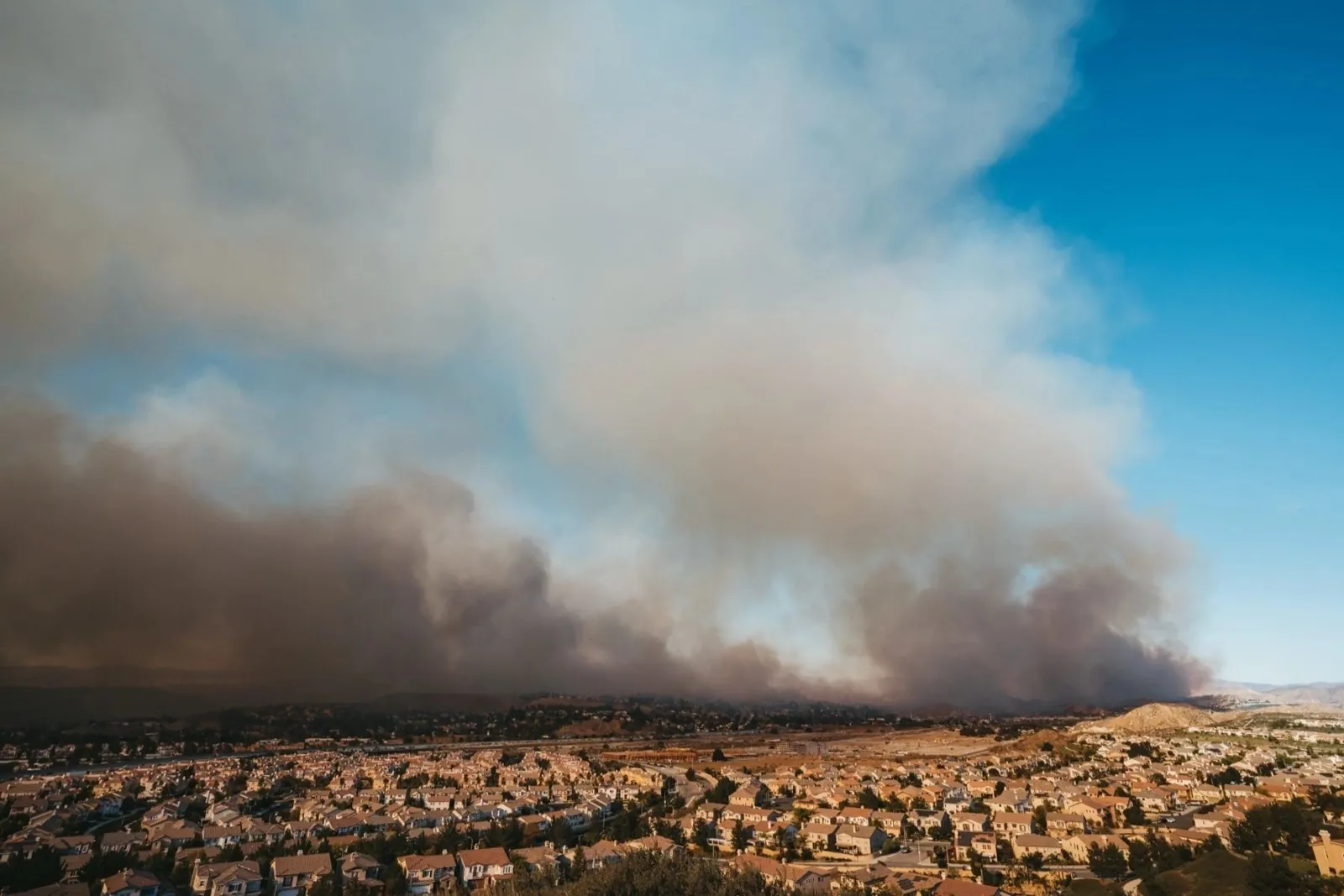
The visible fire perimeter is not the boundary of a wildfire’s consequences. Smoke can cross regions and expose populations that never see the flames.
Population exposure can matter more than proximity
A larger fire does not automatically create a larger health burden.
The health consequences depend on what the fire emits, where the smoke travels, whether it remains high in the atmosphere or descends towards the surface, how long exposure lasts and how many people live beneath the plume.
A remote fire may burn across an enormous area while exposing relatively few people to intense ground-level smoke.
A smaller group of fires can produce a larger modelled mortality burden if the plume reaches densely populated cities and remains near the surface for several days.
This helps explain the North America–Europe difference in The Economist’s analysis. The modelled burden was shaped not only by the size of the fires, but by where the smoke travelled and the population exposed at ground level.
The comparison applies to the incidents, atmospheric conditions and time period analysed. It does not establish that North American wildfire smoke always causes a higher mortality burden than European smoke.
The health effects are broader than one symptom
Wildfire-smoke exposure may cause eye and throat irritation, coughing, headaches, wheezing and breathing difficulty. It can aggravate asthma and other lung diseases and has been associated with cardiovascular effects, hospital admissions and premature mortality.
Risk is not evenly distributed.
Children, older adults, pregnant women, people with existing cardiovascular or respiratory conditions, outdoor workers and emergency responders may face greater susceptibility or exposure. Housing quality, access to health care and the ability to reach cleaner indoor air can also influence vulnerability.
This turns wildfire smoke into more than an environmental issue.
It becomes a civil-protection, occupational-health, healthcare-capacity and infrastructure-resilience issue.
Wildfire smoke is a civil-protection challenge
A major smoke episode can require coordination beyond the organisations managing the fireline.
Relevant bodies may include:
- fire and civil-protection authorities;
- air-quality and meteorological agencies;
- public-health departments;
- hospitals and emergency medical services;
- municipalities;
- schools and care facilities;
- employers with outdoor workforces;
- transport and infrastructure operators;
- and organisations responsible for vulnerable populations.
These organisations do not need to be controlled by one platform. They do need sufficiently current, trusted and role-appropriate information.
Fire authorities may understand the incident’s progression. Air-quality agencies may track the plume and ground-level concentration. Health authorities may understand population vulnerability and hospital demand. Municipalities may need to communicate protective guidance.
The operational objective is not to merge every institution into one command structure. It is to ensure that the public-health consequences of the fire are not treated as an unrelated secondary event.
WHO guidance specifically supports the use of trusted forecasting and exposure information within multi-hazard early-warning and public-health decision systems.
Burned area does not measure the complete consequence
Wildfire reporting frequently begins with hectares burned.
That remains an important measure of geographic scale. It does not reveal:
- how much PM2.5 was emitted;
- how high the smoke rose;
- where the plume travelled;
- whether particles reached ground level;
- how long exposure lasted;
- how many people were affected;
- or which populations were most vulnerable.
A smaller incident can produce a serious urban air-quality emergency. A larger remote incident may produce a different pattern of health and operational consequences.
This is why wildfire analysis should not rely on acreage alone.
Burned area, direct casualties, evacuations, infrastructure loss, air-quality exposure and modelled excess mortality measure different parts of the emergency.
Readiness must extend beyond the flame front
Traditional wildfire readiness focuses appropriately on detection, mobilisation, suppression, evacuation and responder safety.
The smoke-health evidence adds another requirement: authorities must consider consequences that continue beyond the immediate operational perimeter.
At a strategic level, this means connecting:
- early incident awareness;
- authorised field response;
- atmospheric and air-quality information;
- public-health communication;
- operational assessment;
- sustained asset availability;
- and accountable records.
Suppression remains essential. It should not be treated as the only relevant outcome.
After an authorised intervention, operators need to understand whether conditions changed and whether further action may be required. Public-health authorities may separately need to understand whether smoke exposure is increasing or moving towards population centres.
These are related but distinct responsibilities.
Human authority remains central
Wildfire suppression, public warnings and health measures all carry legal and public consequences.
They must remain under the authority of professional agencies and accountable human decision-makers.
Autonomous or remotely operated systems should not independently determine which community receives priority, issue public-health advice or replace incident command.
Their responsible role is to support authorised people with clearer operational information, repeatable capability and better records.
The more capable the technology becomes, the more important governance, supervision and accountability become.
The PRAESI perspective
PRAESI is developing a patented integrated wildfire-response system that publicly brings together field deployment, autonomous aerial suppression, sensing, post-action assessment, repeatable readiness and operator oversight. It is structured as a coordinated response concept rather than as an isolated aircraft, sensor or software product.
PRAESI was not involved in The Economist’s analysis and did not produce the mortality estimates.
PRAESI is not a mortality-modelling platform, public-health authority or air-quality service. It does not claim that its developing system would have prevented the estimated deaths or guarantee reduced smoke exposure.
Its relevance lies at a higher level.
If wildfire consequences extend far beyond the visible perimeter, response capability should be evaluated by more than whether one asset can perform one action. Authorities and stakeholders must also consider speed, field readiness, sustained availability, assessment, coordination and accountable human oversight.
PRAESI remains on a staged proof-build pathway. Deeper technical, operational and partner-integration information is maintained under controlled disclosure.
No proprietary implementation method is disclosed here.
Questions wildfire-health readiness should ask
- How are direct wildfire fatalities distinguished from modelled smoke-attributable mortality?
- Which populations may be exposed outside the evacuation or fire-management perimeter?
- How are wildfire and air-quality data shared with authorised public-health bodies?
- Which hospitals, schools, care facilities and workplaces may need earlier warning?
- How is uncertainty communicated without understating the health risk?
- How does an intervention contribute to a clearer understanding of the evolving incident?
- How is response capability restored during prolonged or repeated emergencies?
- How are operational and public-health decisions preserved for later review?
- How can emerging systems support authorised command without duplicating existing institutions?
- How can wildfire after-action reviews account for consequences occurring far downwind?
These are planning questions, not claims that a single system can calculate or control the complete health response.
Conclusion
A wildfire’s flames may remain within one province, state or country.
Its smoke may not.
It can move across cities, regions and national borders, exposing people who were never close to the active fire. For many of those people, the emergency is experienced not through evacuation or visible flames, but through polluted air.
The Economist’s estimates require caution. The two methods produced materially different numbers, and neither represents an official list of casualties.
But the uncertainty does not remove the underlying risk.
The peer-reviewed evidence, current atmospheric observations and public-health guidance all support the same conclusion: wildfire smoke can produce serious health effects far beyond the fireline.
Firefighters, aviation crews, civil-protection officials, air-quality scientists, healthcare professionals, municipalities and affected communities each see a different part of that emergency.
Responsible wildfire readiness must connect those perspectives without confusing their roles.
Technology cannot eliminate wildfire risk. It cannot turn modelled mortality into certainty or replace professional health and emergency authorities.
It can be developed to support earlier, clearer and more accountable response.
The fire perimeter shows where the land burned.
It does not show how far the consequences travelled.
FAQ
Why is wildfire smoke dangerous?
Wildfire smoke contains fine particulate matter and other pollutants. PM2.5 can penetrate deep into the lungs and may enter the bloodstream. Exposure has been associated with respiratory symptoms, cardiovascular effects, hospital admissions and premature mortality, although individual risk varies by exposure and health status.
Are wildfire-smoke deaths directly counted?
Usually not in the same way as direct fire fatalities. Smoke-related mortality is commonly estimated statistically by comparing expected deaths under observed exposure with an estimated baseline without that exposure. The resulting figures are modelled excess deaths, not a list of identified victims.
Why did the two models produce different estimates?
They used different exposure thresholds, time windows and concentration-response relationships. One emphasised higher-concentration smoke days and immediate effects, while the other included broader exposure and health effects occurring over the following week.
Why was the estimated burden higher in North America?
For the period analysed, major Canadian smoke plumes reached densely populated areas around the Great Lakes and north-eastern United States at ground level. The result applies to those fires and atmospheric conditions; it does not mean North America will always experience a higher burden than Europe.
How should wildfire readiness account for smoke?
Authorities may need to connect wildfire operations with air-quality monitoring, public-health communication, hospital preparedness, municipal planning and support for vulnerable populations. These functions should remain within their respective authorised institutions.
What is PRAESI developing?
PRAESI is developing a patented integrated wildfire-response system connecting field deployment, aerial suppression capability, sensing, post-action assessment, repeatable readiness and operator oversight. PRAESI remains on a staged proof-build pathway and does not claim current mortality-modelling or public-health-system capability.